Accessibility
Adjust the website to how you read and browse. Your preferences are saved in this browser.
Text
Text size
100 %
Contrast
Motion
Pause animations and videos
Turns on automatically if your device has “reduce motion” enabled.
Mi Primer Festival strengthens its commitment to sustainability
Mi Primer Festival is working to reduce the environmental impact of its activities through a Sustainability Plan featuring 28 concrete actions across 8 areas of work. The initiative includes measures to cut emissions, use resources more efficiently, encourage sustainable mobility and improve accessibility.
Organising a film festival also means taking responsibility for its environmental impact. That is why Mi Primer Festival goes beyond raising awareness: it works to measure, assess and reduce the environmental impact of its activities, both in its internal processes and in the festival's production.
To support this commitment, Associació Cultural MODIband has developed a Sustainability Plan in collaboration with specialist consultancy K is for Knowledge. The plan sets out 28 concrete actions across 8 areas of work, supported by monitoring indicators to help reduce greenhouse gas (GHG) emissions and resource consumption.
Measuring to improve: our carbon footprint
Understanding our environmental impact is the first step towards reducing it. The festival has therefore appointed a member of its team to take specific responsibility for collecting and monitoring data on consumption, travel and the waste generated during the event.
Emissions are assessed using a methodology aligned with the GHG Protocol and the ISO 14064 standard. This approach covers three main categories: direct emissions, indirect emissions associated with energy consumption, and other significant indirect emissions across the value chain.
More sustainable energy and venues
The plan also includes measures to reduce the festival's energy impact. These include replacing fuel-powered generators with connections to the electricity grid and prioritising venues and spaces supplied with 100% renewable energy. The festival's offices, for example, are supplied by SOM ENERGIA.
Responsible travel and logistics
Travel is another key area of the plan. The festival prioritises rail travel for all national and international guests and aims to select accommodation close to its venues: within a 10-kilometre radius and, whenever possible, less than 5 kilometres away. Environmental criteria and certifications such as Biosphere are also taken into account.
For logistics, the festival prioritises courier services using non-polluting delivery vehicles, such as Les Mercedes in Barcelona. It also favours digital film delivery, which already accounts for more than 90% of the files received.
Less waste, more reuse
Reducing materials and waste is another central part of the plan. The festival is gradually phasing out printed programmes and replacing them with large-format signage made from 100% biodegradable cardboard.
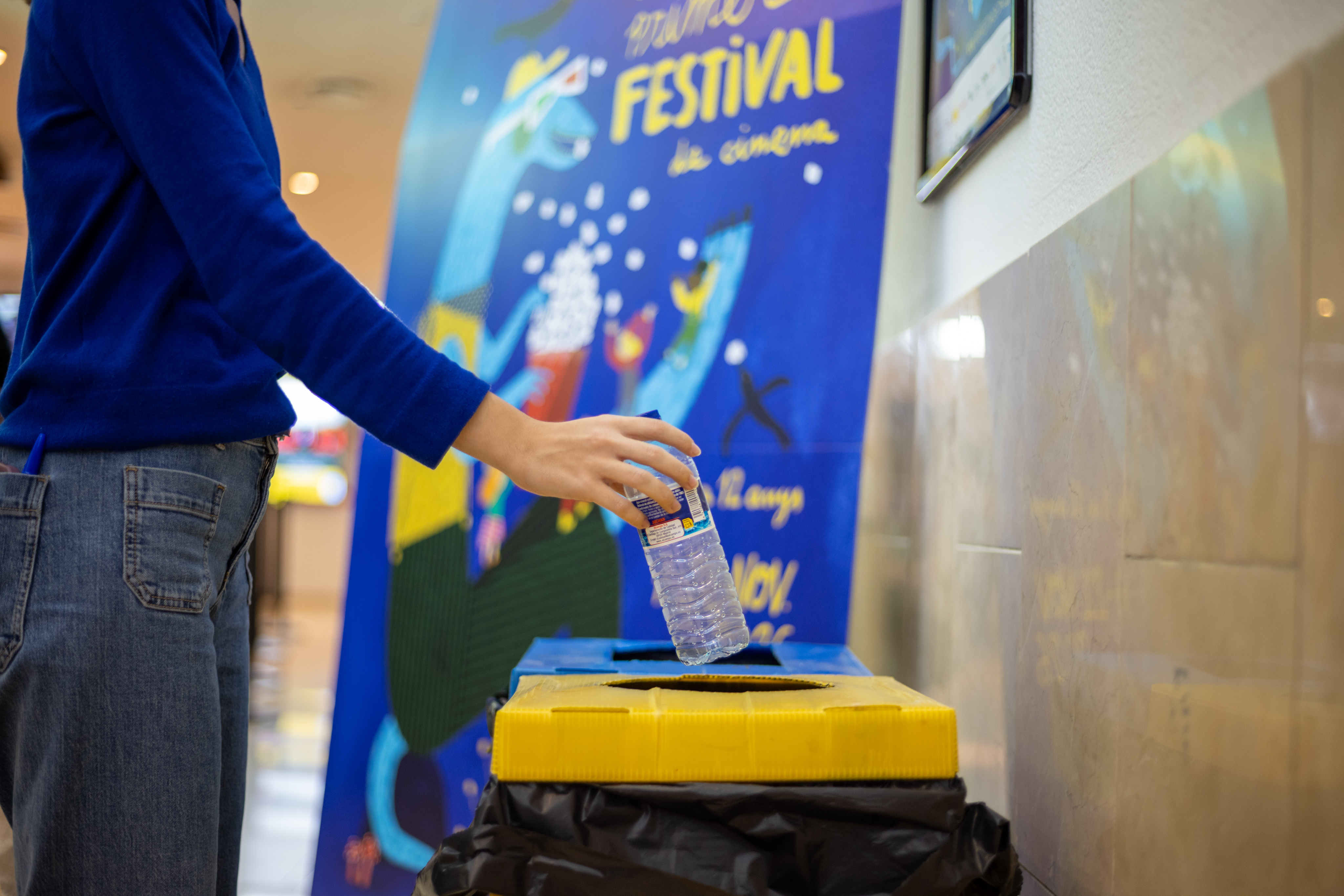
It also reuses items from previous editions, including the photocall, props, box-office structures and cardboard voting boxes first created in 2022.
At the same time, the festival is eliminating single-use plastics by installing water dispensers for reusable bottles and reducing disposable packaging both in catering services and at the venues.
Sustainability also means accessibility
The festival's commitment to sustainability goes beyond environmental considerations. It also takes a broader social approach, recognising universal accessibility as an essential part of the project.
Measures in this area include physical accessibility audits at festival venues and provisions designed to make the cinema experience more inclusive: adapted screenings for people with autism spectrum disorder (ASD), subtitles, sign language and audio description.
Towards continuous improvement
Through this Sustainability Plan, Mi Primer Festival aims to establish a transparent and measurable management model that can serve as a foundation for working towards leading international certifications in the audiovisual and festival sectors.
As part of this commitment, the organisation is working towards obtaining Biosphere Committed certification during 2026, taking another step towards greater sustainability and continuous improvement.